
Digital Operations for healthcare
Building the
Intelligent Clinic.
Where AI works & People Lead
ConverGen enables you to create Digital Workers (DW): AI colleagues that carry each patient journey from start to finish, inside your systems, under your team’s direction. Every new AI capability adds up to a clinic that runs better, not one more tool to manage.
Where organizations are today
AI is already everywhere.
The work still falls through the cracks.
If more AI has meant more to manage, not less, you are not alone.
Your teams already use AI: a scribe in the exam room, a chatbot on the website, an assistant inside the payer portal, staff pasting text into chat tools. Each one helps with a step.
Yet referrals still go unscheduled, authorizations still expire, and someone still has to remember to follow up. Every new tool adds a login, its own rules, and one more thing for your team to manage.
- >90%
of U.S. health systems have deployed third-party AI1
- 44%
keep a dedicated environment to test it1
- 63%
call their AI strategy developing or ad hoc1
- 81%
of physicians use AI in their work, up from 38% in 20232
Sources and scope
(1) Center for Connected Medicine and KLAS Research, health system AI adoption and governance, 2026. (2) American Medical Association, Physician Survey on Augmented Intelligence, 2026. Survey results, as reviewed in Insurable Digital Labor.
Today’s gaps
More AI is not more work done.
What’s missing is structure.
Six structural gaps explain why. Each is examined in a Live Article, and each has an answer in DOpS.
- 01The DOpS answerEvery journey gets a steward.
No one owns the work between the tools.
Each tool helps with one step. The follow-through belongs to no one.
Read: The Human-Digital Organization - 02The DOpS answerContext is governed, not guessed.
Models don’t know your organization.
They don’t know which policy governs this plan, or what your supervisor wants escalated.
Read: Organizational Context as Infrastructure - 03The DOpS answerReliability is engineered.
Capable is not the same as dependable.
In one benchmark, agents completed 82.8% of single steps but only 36.3% of whole tasks.
Read: Operational Reliability in Healthcare AI - 04The DOpS answerEvery action is bounded and evidenced.
Unmanaged agents become liabilities.
Shared credentials, no supervisor, no record: nothing to audit, explain, or insure.
Read: Insurable Digital Labor - 05The DOpS answerYour know-how stays yours.
Your know-how leaks out.
When your rules and lessons live inside vendors’ products, you can’t explain your own work.
Read: Creation and Control of a Digital Workforce - 06The DOpS answerWork becomes memory.
Lessons disappear.
Corrections are made once and forgotten. Nothing changes how the next case is handled.
Read: Digital Operations Turns Work into Memory
These are not problems of intelligence. They are problems of management, and healthcare already knows how to solve them for people.
The idea
Give AI a job, the way you’d onboard a new hire.
A Digital Worker (DW) is an AI agent given everything a responsible organization gives a new colleague: a defined role, a supervisor, the access the job needs and no more, your rules and context, and a record of its work.
Its authority grows as it proves itself, and it can be pulled back. Digital Workers are AI agents, built and managed the right way. The name signals a managed role, not a person.
| Question | A typical AI agent | A Digital Worker |
|---|---|---|
| Who it answers to | No one in particular | A named supervisor on your team |
| What it knows | General knowledge | Your rules, your sources, and the current case |
| What it can touch | Whatever its credentials allow | Only the systems its role needs |
| How its authority changes | Set once, at setup | Earned on evidence, task by task, and revocable |
| Who owns it | The vendor | You |
How it works
A digital colleague that works across your systems.
Like a colleague working remotely, a Digital Worker uses the systems your team already uses, calls specialist AI tools for single steps, and brings people in where judgment matters. It follows the work, not the org chart.
Your team
Assigns work, approves decisions, and can pause it.
Your systems
The same screens and inboxes as your staff, or an API.
Specialist AI tools
Called for one step; the result is checked.
Your rules and context
Which policy governs, and when to ask a person.
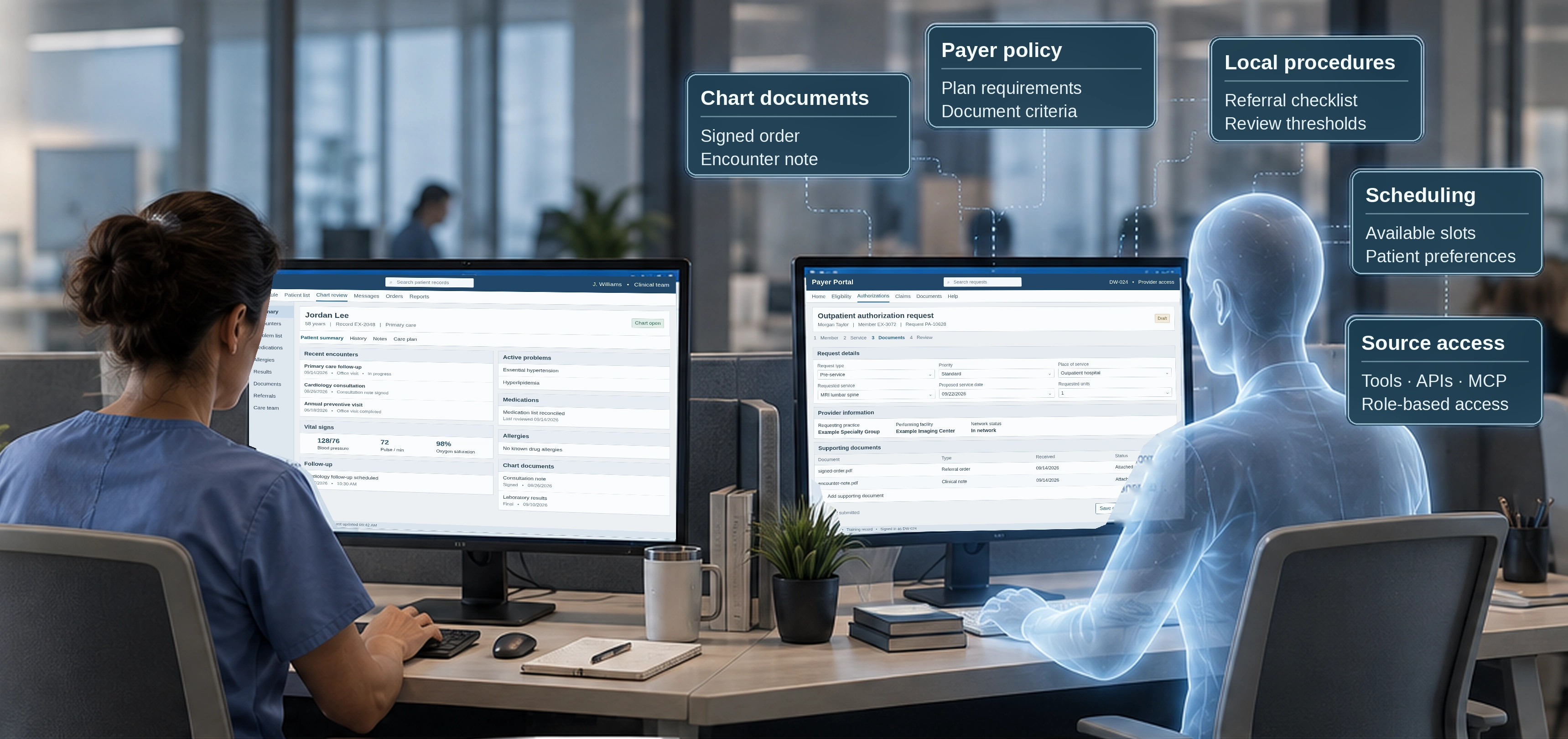
One record of everything it does: what it used, what it decided, who approved, and what happened.
Created from the inside
Imagined and built like a new hire.
Limited only by your imagination.
You start from the work, not from a product catalog. Describe what needs doing, and the AI Advisor asks the questions an experienced manager would: which payers, who approves, what must never happen without a person. Each answer adds know-how fitted to your rules.
Because Digital Workers aren’t tied to one department, a role can span whatever the work requires.
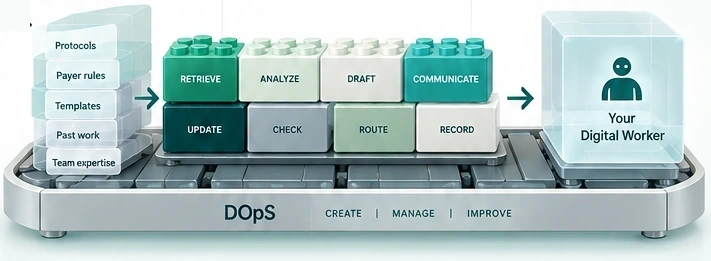
Trust is earned, task by task. A new Digital Worker starts in shadow mode on real cases, without changing anything. Authority grows one task at a time as evidence builds, and a supervisor can narrow it at any time.
Why structure matters
Spinning up agents is easy.
Running Digital Labor safely takes a system.
It is tempting to let every team launch its own agents. Without structure, they multiply into something no one can see, control, or insure. Digital Labor is high-stakes work, so most of what we build is about safety, control, and accountability.
AI governance decides whether a use is acceptable. Digital Operations runs the allowed work every day. DOpS, the Digital Operations System, is where you create, supervise, and improve your Digital Workers.
Five questions your board will ask about AI.
- 1VisibilityAsk aroundIn the record
Which AI systems are doing work in our organization right now?
- 2OwnershipAsk aroundIn the record
Who supervises each one, and what is it allowed to do?
- 3ContextAsk aroundIn the record
Which sources does it rely on, and are they current?
- 4EvidenceAsk aroundIn the record
Can we reconstruct what it did, and who approved it?
- 5ControlAsk aroundIn the record
Can we narrow or stop it ourselves, without calling the vendor?
If the answers aren’t in a system of record, you have AI deployments, not AI operations.
See how DOpS answers each oneIn practice: the Intelligent Clinic
See it in a clinic.
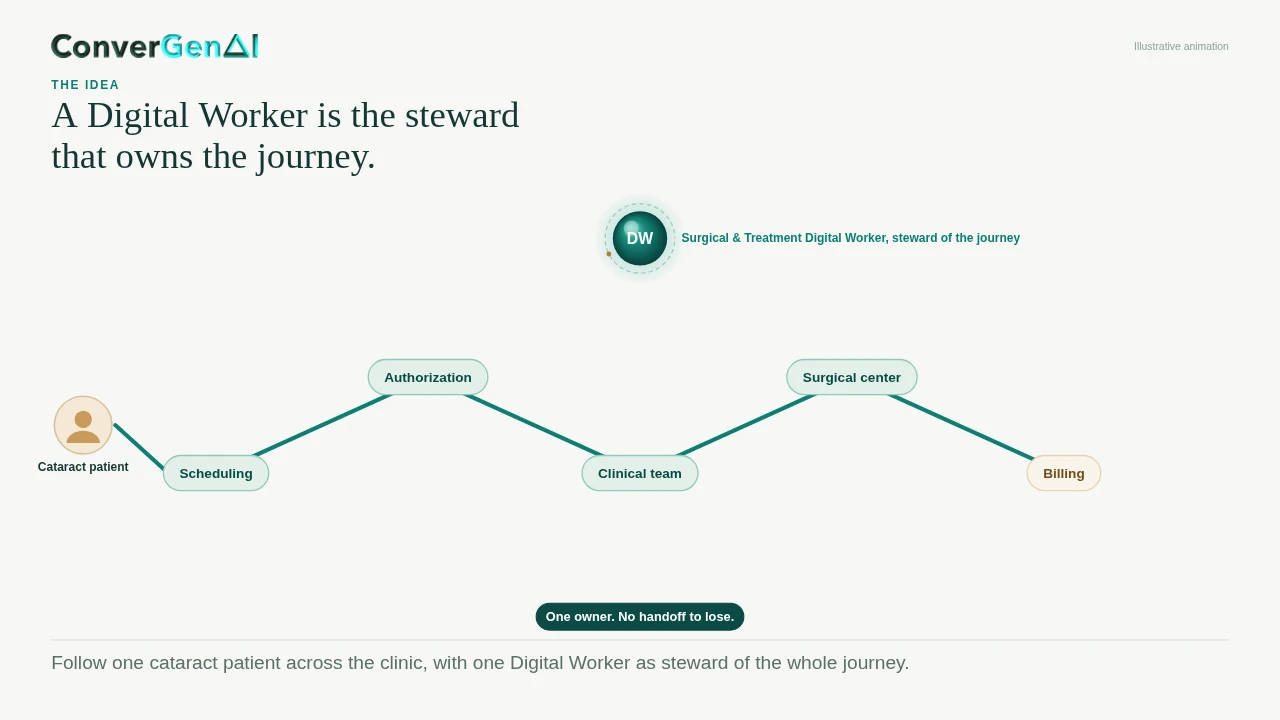
From “you need surgery” to the holiday card.
We show the approach where the work between the steps is hardest to see: an ambulatory surgical clinic, run with five Digital Workers. Follow one cataract journey across it. People make the decisions. The Digital Worker carries the context, coordinates the work, and keeps the family informed.

Why ConverGen
Helping define how
AI work is managed.
Fabio Thiers, MD, PhD, MBA
Founder & CEO. Physician-scientist and healthcare-technology entrepreneur, and author of the Live Articles that introduced Digital Workers, Digital Labor, and Digital Operations.
The thinking behind the work
Ten public Live Articles set out the vocabulary, the architecture, and the evidence, with their sources and limits.
Browse the Live ArticlesWe use Digital Workers internally and are implementing with healthcare organizations. Operational outcomes are not yet established. Website examples are illustrative.
Where this leads
Delivering the Intelligent Organization.
Where AI works & People Lead
Start with one journey that stalls, not an organization-wide transformation. You do not need a complete AI strategy to begin.