
Digital Workers
A continuing role in your organization.
Create a Digital Worker with a defined role, a persistent identity, and memory that builds over time. It carries responsibility across cases, systems, and conversations, as part of your team.
The role persists. The experience accumulates.
A Digital Worker takes on a defined organizational role, not a one-off request. Its identity, local knowledge, and operating history remain with it as cases close, new work arrives, and the underlying AI or tools change.
Your team works with the same managed worker over time: a named supervisor, clear authority, and a maintained record of decisions, corrections, and outcomes. Approved lessons inform future work rather than disappearing when a conversation ends.
Read the distinctionIdentity & role
Continuing responsibilities, a supervisor, and defined authority.
Context & case continuity
Your approved knowledge, open cases, and the next steps.
Memory & operating history
Decisions, outcomes, coaching, and lessons retained over time.
A Digital Worker in practice
A digital colleague. Working through your systems.
The AI works in the background, while its responsibilities and activity remain visible. You work with it as you would with a remote colleague: assign work, ask for an update, review a decision, or explain a better way.
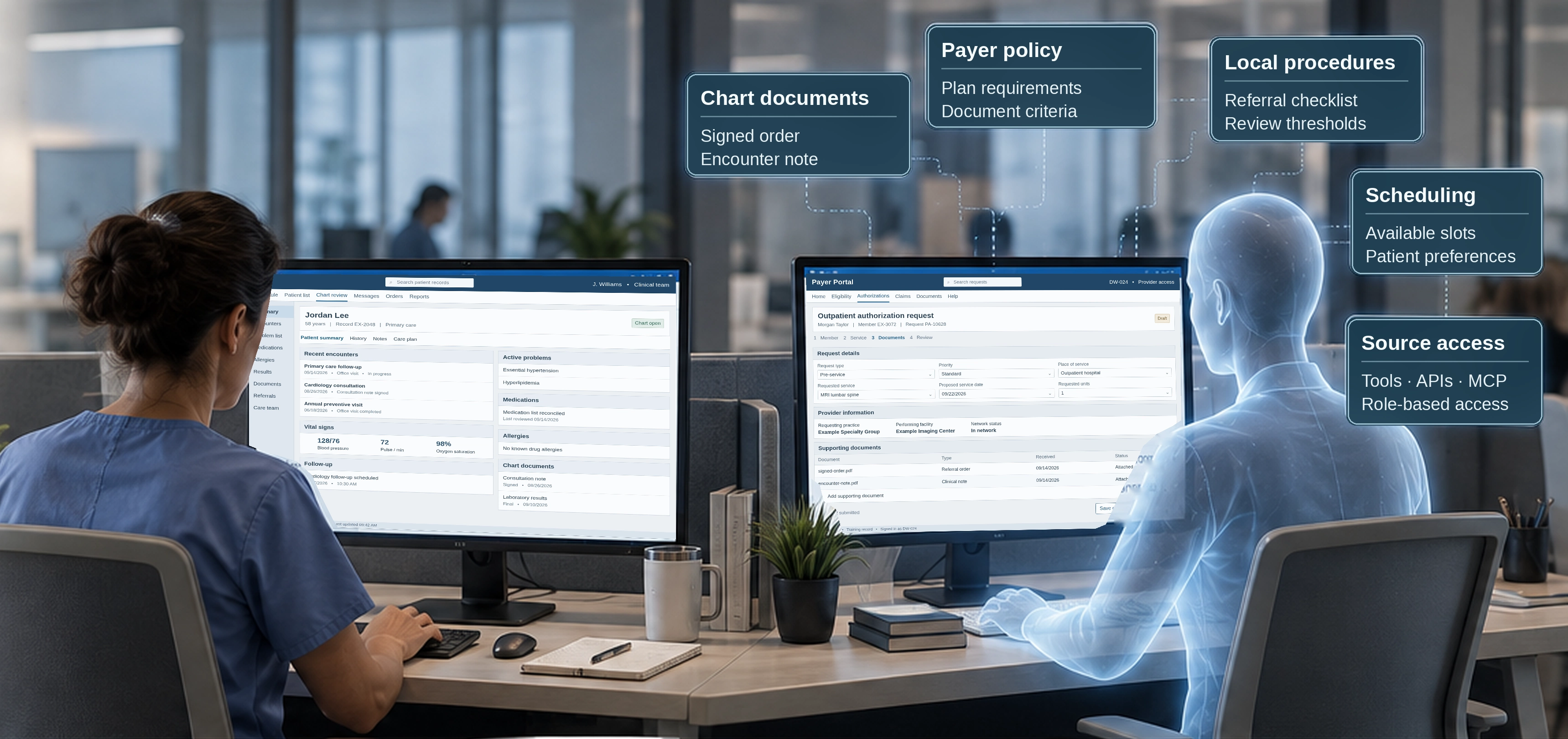
A familiar point of contact for complex work.
A Digital Worker can operate a computer workspace with its own credentials, using approved integrations or supported software screens. It can also draw on tools, APIs, and MCP connections, bringing relevant information across systems into one view of the work. Access follows its role, permissions, and approved sources.
It keeps track of the work between conversations. Your team can ask about progress and receive a grounded answer, with the underlying records available for review.
How is it going today?
The routine follow-ups are progressing. One referral is waiting for documentation; another needs your decision. I have kept both open and prepared the details.
Review the queue, source records, and next responsible person.
Bounded access
Dedicated credentials and permissions matched to its role.
Human direction
A named supervisor can review, correct, redirect, or pause activity.
Auditable work
Actions, sources, and approvals connect to the worker’s maintained record.
People, Digital Workers, and the systems they use form one coordinated operation. The human team is part of that system, not an oversight layer outside it.
Growing capabilities
The same worker grows with your organization.
Begin with referral tracking. Add documentation preparation and handoff follow-through to the same worker, with each change approved by your team.
Clinic Operations Coordinator
Keep the worker.
Build on what it knows.
-
Begin with a defined role
Track referrals
Referral trackingMaintains referral status, identifies missing information, and routes stalled cases to the right person as new work arrives.
-
Add a related capability
Prepare documentation
Documentation preparationReferral trackingKeeps tracking referrals and adds document gathering and packet preparation, using case history and the local procedures your team has taught it.
-
Extend the contribution
Follow handoffs
Handoff follow-throughDocumentation preparationReferral trackingKeeps tracking and preparation, follows pending handoffs, and summarizes unresolved work for the supervisor. Earlier corrections and approved lessons continue to inform its work.
Your coordinator leads decisions and conversations that need a person. Your team approves added responsibilities, capabilities, access, and review requirements. Preparing a packet does not authorize sending it.
Role, identity, local knowledge, memory, and operating history carry forward.
Define the result that matters: a current referral, an arranged appointment, or a confirmed visit.
AI-guided creation
The people who know the work can create the worker.
You bring the knowledge of your operation. The Digital Operations Advisor brings maintained healthcare-process knowledge, embedded Task maps, and control requirements. It knows which questions to ask, what may be missing, and what each choice changes.
Embedded Task knowledge
Operating Maps, Steps, and completion rules.
Reusable capabilities
Skills, Tool use, and approved connections.
Your operating context
Local procedures, permissions, and Controls.
Your Digital Worker
Your team reviews, authorizes, supervises, and coaches.
See how the Advisor shapes the worker+
“Our referrals stall when the receiving office needs more documentation.”
“Which records does that office require? Where is the current checklist? Should the worker only prepare the packet, or also send it after approval?”
Review the creation steps+
Explain your operation.
Describe the continuing responsibility and share the procedures you already use. The Advisor asks about the sources, exceptions, handoffs, and completion rules specific to that work.
Resolve the design together.
The Creator loads the relevant Tasks, Steps, Skills, Tool use, and Controls. The Advisor flags gaps and risks, identifies credentials and permissions, and captures your local variations.
Review, authorize, and coach.
Review the worker design and test it in your setting. Authorized owners approve access and actions. Your team then supervises and improves the same worker through conversation.
Deep operational knowledge becomes the starting qualification, not coding expertise. DOpS guides the design and keeps the requirements explicit; your team retains approval of access, scope, and consequential decisions.
More functions. The same managed worker.
A worker can combine related responsibilities rather than remain limited to a single workflow title. Its identity, context, memory, and operating history persist as capabilities change. When responsibilities require unrelated supervision or authority, a separate worker may be the clearer design.
Your organization stays in charge of how the worker’s responsibilities and permissions evolve.
See the system that supports itDefine
Purpose, knowledge, and responsibilities.
Supervise
Progress, decisions, and exceptions.
Improve
Reviewed changes and retained learning.
Risk & insurability
A clearer operation. A clearer basis for insurance.
A persistent worker gives risk managers and insurers something stable to assess: its role, authority, work volume, controls, and history. The question becomes how the operation is run, not simply which AI model it uses.
Without a shared operating structure
Policy and execution can remain disconnected.
With Digital Operations
The role and the record stay connected.
Separate activity records
One continuing record Agentmatics
AI tools, agents, and conventional automations may each have permissions and logs, yet no common record connects them to the work, its supervisor, or its consequences.
A governance policy defines what should happen. On its own, it does not establish what happened in operation.
The persistent role brings work volume, consequential actions, safeguards, and outcomes into a shared operating record, including dependencies across workers.
Agentmatics continuously connects these signals to the worker’s operating record.
What Agentmatics connects
- Role
- Identity, responsibility, supervisor, and current authority.
- Exposure
- Work volume, consequential actions, and shared dependencies.
- Controls
- Permissions, approval checks, and evidence that safeguards operated.
- Behavior
- Outcomes, exceptions, corrections, and incident history.
Make risk assessable as the work evolves.
Unclear exposure can lead to conservative pricing, restricted cover, or AI exclusions. DOpS supplies evidence for assessing the managed operation across workers, people, and tools. Your broker and insurer use that evidence to evaluate coverage and price.
What could your team do with more capacity?
Start with the work you want to improve. We will help you identify a useful next step.